
Green infrastructure provides a wide variety of ecosystem services.
Ecosystem services can be grouped into four categories:
- Provisioning (e.g., food supply)
- Regulating (e.g., climate control)
- Supporting (e.g., soil formation)
- Cultural (e.g., recreation)


Since ecosystem services have tangible benefits for humans, some of which can be assigned a monetary value, incorporating these ecosystem services into discussions and decision-making greatly enhances the perceived overall value of green infrastructure relative to its costs.
Toronto and Region Conservation Authority (TRCA) is at the forefront of quantifying, valuing, and mapping the ecosystem services provided by green infrastructure.
TRCA’s Ecosystem Services Projects
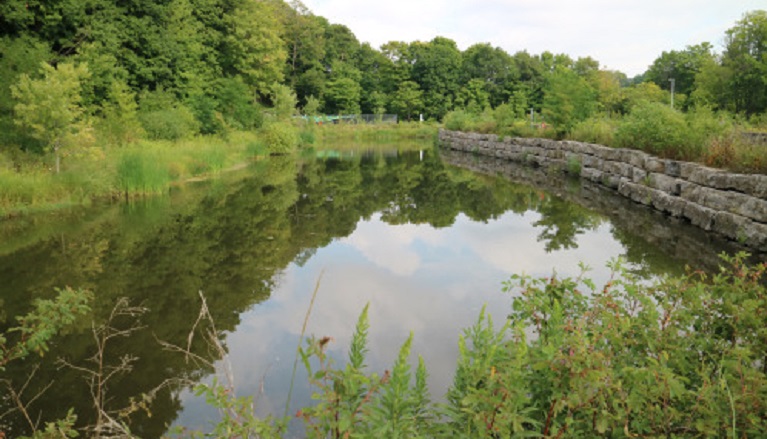
Valuation of Ecosystem Services in Toronto’s Parks, Golf Courses, and Open Green Spaces
This report quantifies and monetizes the ecological, social, and economic benefits provided by the City of Toronto’s public green spaces.
Using spatial modelling and valuation methods, the study assesses services such as stormwater retention, carbon storage and sequestration, air quality regulation, heat mitigation, food production, and human health benefits.
Aimed at supporting evidence-based urban planning and asset management, the report’s intent is to demonstrate how Toronto’s natural assets function as essential infrastructure.
By valuing and mapping these ecosystem services, the study provides a scientific foundation for guiding conservation, restoration, and investment decisions that enhance climate resilience, reduce infrastructure costs, and improve the city’s livability.
Natural Asset Carbon Assessment Guide and Toolbox
Conservation authorities and municipalities are increasingly interested in accounting for the benefits provided by green infrastructure for mitigating climate change.
Collaborating with Credit Valley Conservation (CVC) and Lake Simcoe Region Conservation Authority (LSRCA), TRCA published a guide in 2022 to estimate carbon sequestration and storage by various types of green infrastructure, including trees and forests.
In 2025, version 2.0 of the guide was updated with carbon storage and sequestration rates for forests and wetlands. It was published in collaboration with CVC and LSRCA, and funded by Environment and Climate Change Canada.
DOWNLOAD VERSION 2.0 OF THE GUIDE

GTA Forest Carbon Quantification and Valuation
TRCA, supported by the 452 Foundation, has applied the Natural Asset Carbon Assessment Guide and Toolbox to estimate the carbon storage and sequestration rates of forests across the Greater Toronto Area (including the City of Toronto and Regions of Halton, Peel, York, and Durham).
These results were then valued using the 2025 Social Cost of Carbon to determine that the GTA’s forests are worth $51 billion in carbon storage and $476 million annually in sequestration.
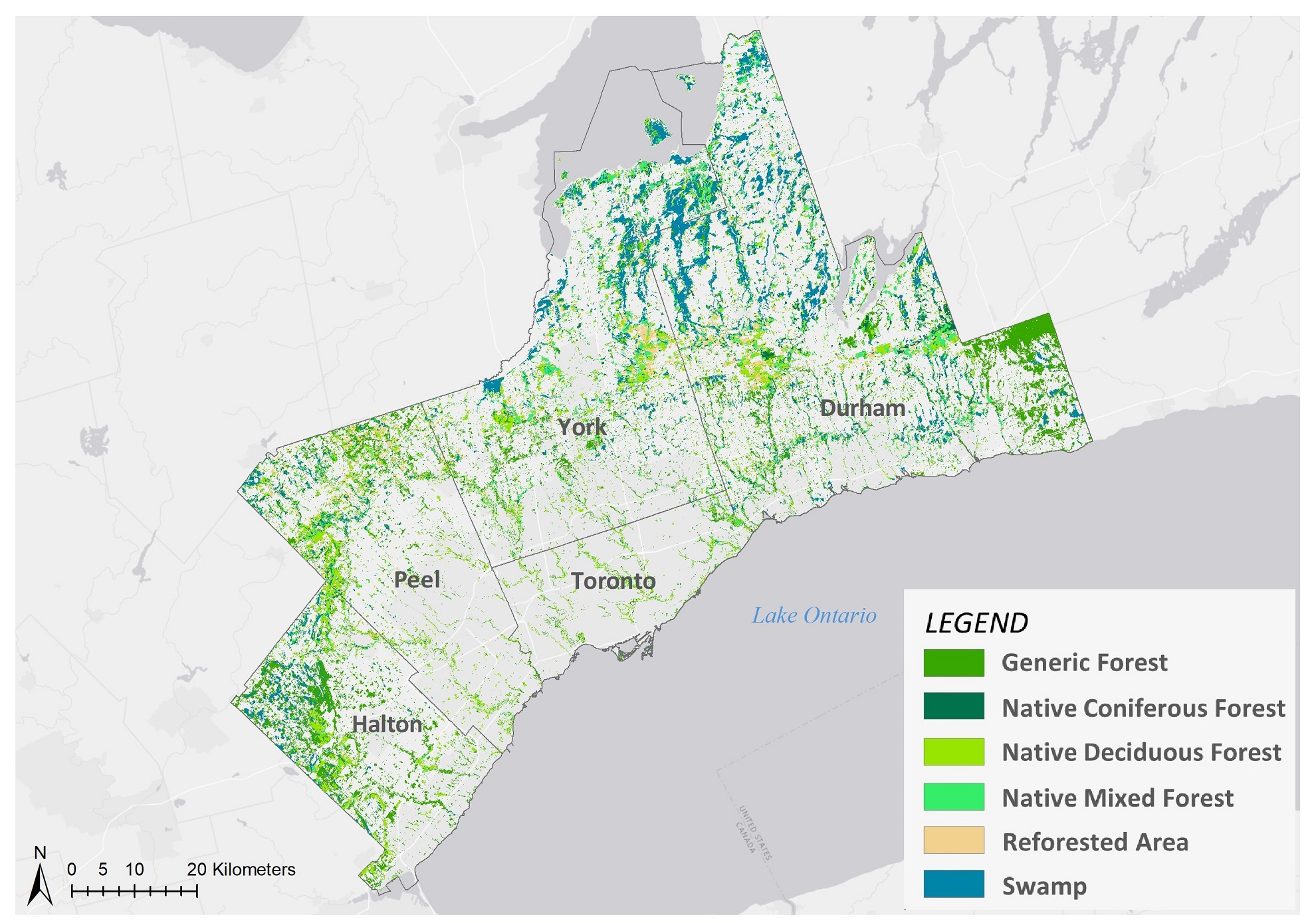
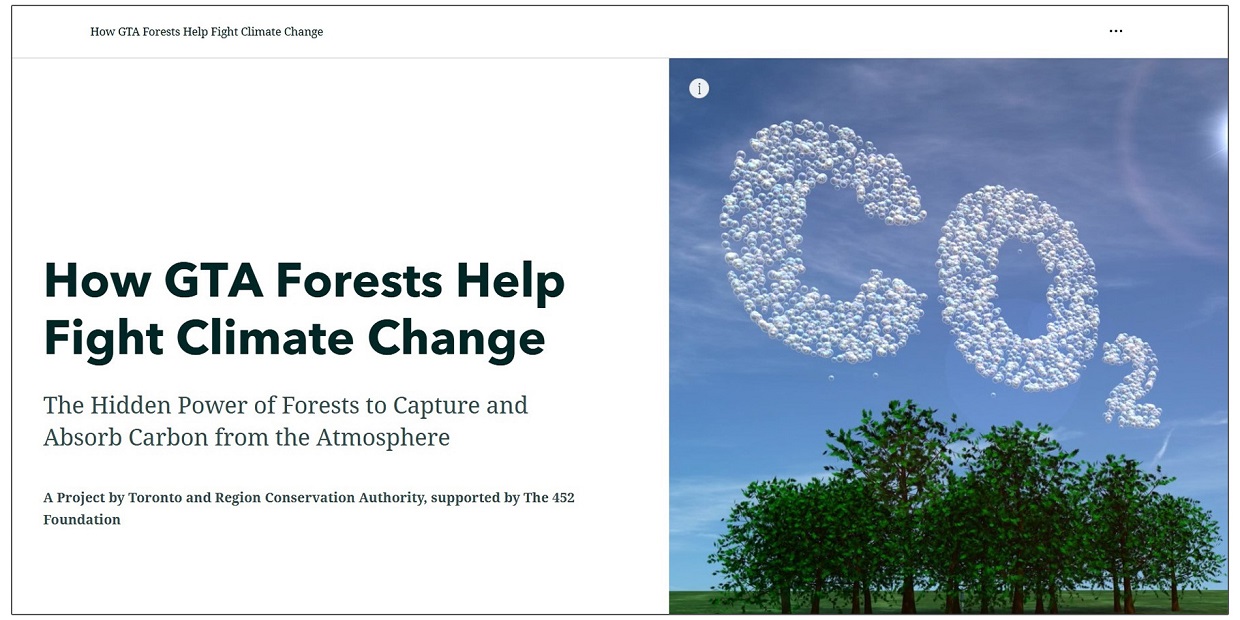
The objective of this project was to create a comprehensive and accessible resource to highlight the importance of forest carbon reserves in the GTA and to provide decision-makers and the public with a clear understanding of the critical role forests play in the fight against climate change.
A public StoryMap was created to share project methodology and results, including maps, graphs, illustrations, and an interactive dashboard. The dashboard summarizes storage and sequestration rates by either unique forest type or municipality; users can also zoom to the neighbourhood scale to focus the results further.
Select the thumbnail image below to view the StoryMap.
Nature-Based Climate Solutions Siting Tool
Nature-based climate solutions (NBCS) offer ecosystem-based approaches to address societal challenges, environmental health issues, and climate change.
NBCS can include the protection or restoration of natural features and areas such as forests, wetlands, and meadows, as well as the implementation of other green infrastructure assets such as street and backyard trees, green roofs, and rain gardens.

NBCS has received growing interest among the scientific and policy communities over the past few years.
The Nature-Based Climate Solutions (NBCS) Siting Tool was developed by TRCA and partners with grant funding from the Government of Canada’s Nature Smart Climate Solutions Fund.
This tool identifies strategic locations for nature-based projects that protect, restore, or enhance natural areas while considering multiple benefits and trade-offs.
LEARN MORE about the (NBCS) Siting Tool
Municipal Green Infrastructure Quantification and Valuation
TRCA supports municipalities by developing reliable methods to quantify and value ecosystem services for a variety of natural assets.
We are exploring carbon storage, water runoff reduction, improved air quality, and more.
TRCA is investigating the use of various tools and methods to map co-benefits of green infrastructure such as urban forests and natural cover.
Select the thumbnail image below to view a TRCA StoryMap comparing urban forest, natural cover, and forest cover.

Contact
TRCA Watershed Planning and Ecosystem Science: wpes@trca.ca