
Registration for Our 2026 Program is
NOW OPEN
PROGRAM DATES
Online Component: July 20 to August 23, 2026
Classroom & Field Component: August 7 to 23, 2026
Register Now for the 2026 Program
Download & Print Our Poster
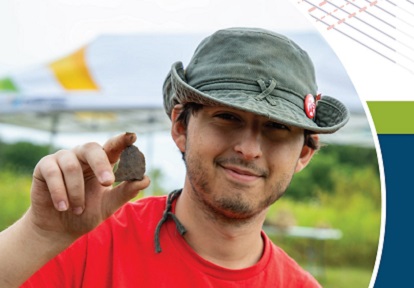
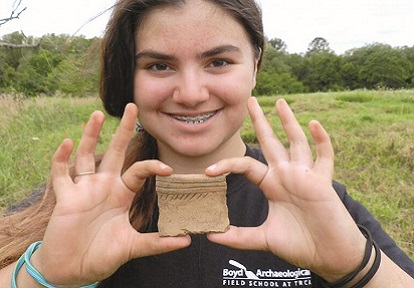
Founded in partnership with the Royal Ontario Museum in 1975, the Boyd Archaeological Field School (BoydFS) is Canada’s premier high school credit course offering students the opportunity to earn Ontario High School credits while participating in real archaeological fieldwork alongside industry experts.
IN COLLABORATION WITH:
Durham District School Board – Durham Continuing Education


Register Now for the 2026 Program
Aug 7-23, 2026
| Ontario Students – $3,500.00 | Register Now |
| Non-Ontario Students – $3,900.00 | Register Now |
VIEW OUR PHOTO SLIDESHOW
BoydFS has assisted with the documentation of several Ontario archaeological sites, most recently conducting excavations at the Sebastien site, an 800-year-old Middle Iroquoian village located in Pickering, Ontario.
“This course has been a life-changing experience. I absolutely loved everything … Thanks to all the staff members and the students for making this journey so memorable!” – Shamim
Since 1975, more than 1,500 Canadian and international students have experienced local archaeology through the program.
Many alumni have gone on to pursue post-secondary studies, advanced degrees, and careers in archaeology, anthropology, law, and related fields of paleontology, geology, and forensics.
“The staff and students were so kind and welcoming. The memories and friends you make will last a lifetime. I managed to get a job in archaeology a month after I graduated from field school, which says something about the value of the experiences you gain!” – Naomi, Class of 2023

QUICK LINKS

About the Boyd Archaeological Field School
BoydFS is a dual credit program offered online and in-person at the Claremont Nature Centre in Pickering, Ontario.
Students gain important career skills through our online content and background material on archaeology and Indigenous history, through classroom sessions, and gaining on-the-job training in real archaeological skills.

This experiential course challenges students to strive for new levels of achievement in a team environment. Learning experiences include:
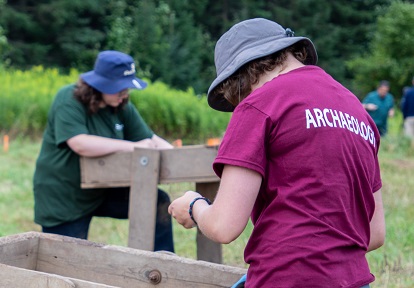
- Excavation of a real archaeological site.
- Hands-on activities such as flintknapping, basketry, and other ancient technologies.
- An academic classroom component featuring sessions led by certified teachers and professional archaeologists, as well as guest lectures from leading experts.
- Career and community connections.


Credits
- A combination of field work and classroom studies (both online and in person) confers a Grade 12 Interdisciplinary Studies (History of Ontario/Archaeology Focus) credit (IDC4U/O) and a Grade 11 Co-op credit, DCO3O – Creating Opportunities through Co-op.
- The courses meet credit expectations defined by the Ontario Ministry of Education.
- Requirements:
- Completion of grade 10 (by start of online course)
- Ontario residency
Note: Non-Ontario students are welcome but are subject to additional fees for credits. (See fees section.)
Prerequisite
- Completion of Grade 10 by start of online course.
Staff
- Course instructors include certified Ontario teachers, licensed archaeologists, Indigenous educators, and respected professionals in a variety of specialties.
- 1:5 staff to student ratio at excavation site, minimum 1:14 at Claremont Nature Centre.
Location
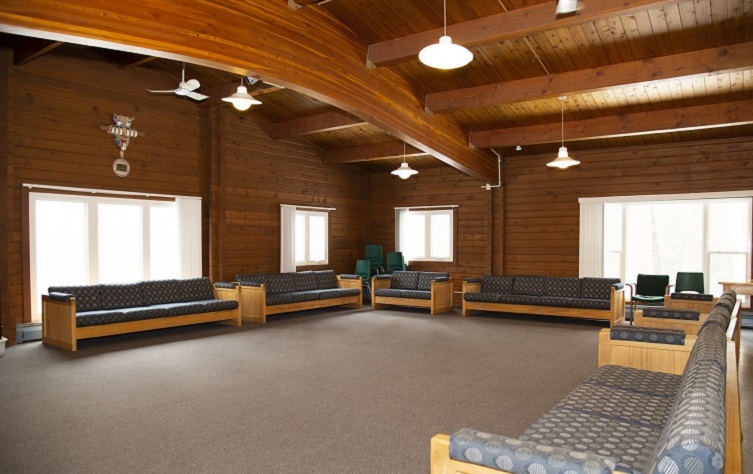
- Claremont Nature Centre is an outdoor education facility on conservation land in Pickering, Ontario. The dorms, classrooms, lounge, and dining hall are all housed in a cedar chalet-style building constructed in 1970. Learn more about Claremont.

Course Content
Co-op Program (DCO3O):
Online and In-person
Students begin their journey online through the virtual learning platform (D2L Brightspace), where they explore topics such as workplace health and safety, rights of the worker in Ontario, and value-added skills such as scale map creation, profile mapping, research methodologies, and academic citation methods.
Students will also prepare for the in-person session by familiarizing themselves with Southern Ontario Pre-history. Additional readings, etc., will be available for students interested in extending their knowledge prior to the in-person session.
The online course is offered asynchronously, allowing students flexible timelines to complete course materials and assignments. Students should expect to spend approximately 30 hours to complete the requirements before arriving at Claremont Nature Centre.
Once on site at Claremont, students will complete the remaining co-op related content. Lastly, students will work with the teacher to create a resume/cover letter that best highlights their new skills learned in this program.
“I just wanted to take the time to tell you how thrilled [we] were that Rachel got an opportunity to attend this school. She truly enjoyed it and said even though it was one of the hardest experiences of her life, it was also one of the best! This program helped make her a stronger, more mature and focused individual.” – David and Asia Belcher
Interdisciplinary Studies (History or Ontario/Archaeology Focus) (IDC4U/O):
In-person Instruction and Field Excavation Program
Over 17 immersive days, students will journey through time, uncovering Ontario’s rich and diverse history through hands-on learning experiences such as flintknapping and basket making – all while participating in the excavation of a real archaeological site.
Beyond learning the techniques of archaeological fieldwork, students develop the mindset of an archaeologist: asking questions, making connections, and thinking critically about the past.
Through guided interpretation and analysis, participants explore how artifacts end up in the ground, who created and used them, and what these clues reveal about the people and environments of the past.
By combining discovery with reflection, students gain a holistic understanding of the site and the stories it holds.


More About the Online Component
The cooperative education course operates throughout the program both online and in-person. Utilizing the work experience in the field and instructional topics that compliment this introduction to the workplace, this co-op credit prepares students for their future endeavours.
Students will:
- Earn a micro credential in Health and Safety in the Workplace
- Earn a micro credential in WHMIS
- Explore careers in industries related to Archaeology
- Learn communication and teamwork skills
- Learn how to read and create topographic (contour) maps
- Create profile or cross-section maps (to scale)
- Practice proper academic research and citation methodologies
- Examine the rights of a worker in Ontario
- Reflect upon their work experiences in the field
- Review and upgrade resumes and cover letters
- Learn value-added skills such as responsibility, perseverance, patience, determination, cultural humility, understanding, etc.
More About the Classroom Component
While some content is delivered through lectures and seminars, the non-field portion of our course includes many hands-on, outdoor sessions devoted to activities such as flintknapping and exploring ancient technologies.
In addition to our own teaching staff, leading guest experts offer instruction as well.
Topics explored include:
- What is archaeology: an introduction to archaeological theory
- Analysis and identification of artifacts
- Flintknapping (stone tool-making workshop)
- Origins: First Peoples of the Americas
- Southern Ontario Prehistory (time periods)
- Awareness of human interactions with the natural environment
- Iroquoian Society: the Huron-Wendat at the time of contact
- Introduction to modern Indigenous philosophies, worldview, and contemporary social issues
- Exploring career opportunities in archaeology, heritage, and beyond
- Career skills such as teamwork, communication, and health and safety
More About the Field Component
Students will excavate at the Sebastien site in Pickering, Ontario, a short 10-minute drive by school bus from the Claremont Nature Centre.
In the 14th century, this site was the location of an ancestral Wendat settlement. The area is high on a drumlin and was rich in resources including lumber and woodland creatures, and near a creek providing water and fish.

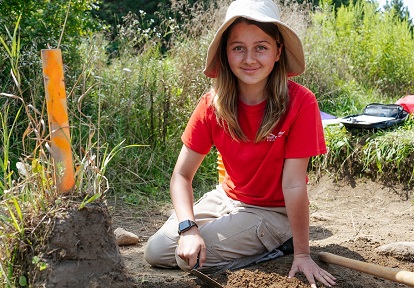
Students are responsible for the complete scientific excavation of a two one-metre square units, the recovery of any artifacts within, and the mapping of features that contribute our mapping of the village’s settlement patterns.
Students will contribute real archaeological data to our knowledge of this time period in southern Ontario history.
All excavation is supervised by TRCA’s licensed professional archaeologists and their staff of field assistants.
Staff also conduct laboratory sessions on artifact identification and other fieldwork-related topics to help guide students through the program assignments and tests.
Course Fees
- Ontario Students: $3,500.00
- Canadian and International Students: $3,900.00*
*For more information on non-Ontario residents and international students who wish to obtain high school credits, please contact BoydFS@trca.ca or DCEInfo@ddsb.ca – Attn: Curriculum Lead – Credit Programs.
Course fee includes the following:
- 17 days of meals, accommodation, and programming
- Supplies for experimental archaeology projects
- All printed course materials
- School bus to the archaeological site
- Instructional staff
- Guest lecturers


Scholarships & Bursaries
The Sebastien Scholarship
This scholarship, covering the full fee for the course ($3,500.00), is available to any TWO Canadian high school students of First Nations, Métis, or Inuit heritage.
Learn More and Apply
PURPOSE:
To cover the full course fee of the Boyd Archaeological Field School (currently $3,500.00) for a Canadian student of First Nations, Métis, or Inuit heritage.
BACKGROUND:
The Sebastien Scholarship offers an opportunity to students of First Nations, Métis, or Inuit heritage and a serious interest in archaeology who might be unable to attend without financial assistance. It honours Heather Sebastien, a Huron-Wendat Nation elder from Wendake, Quebec, who visited the site on occasion as part of municipal and provincial engagement with Indigenous communities.
ELIGIBILITY AND EVALUATION:
Available to any two Canadian high school students of First Nations, Métis, or Inuit heritage, status or self-identified.
Students should have completed Grade 10 and be no older than 21 years at the time of the course.
Applications should include two letters of reference from a community leader (e.g. elder, council member, teacher, principal, or guidance counsellor) who can attest to your Indigenous heritage or background.
Each letter is to include the student’s mailing address, telephone number, and email address (of the student and a parent).
Students are asked to provide a 500-word essay (written or recorded orally) outlining:
- How they feel archaeology can help them explore their heritage and enrich the traditional histories of their people
- How they might share the knowledge they gain with their community and the broader population of Canada
- What their own aspirations are for future studies and career
For the reference letters, please ask your endorsers to highlight your experience with:
- Traditional culture and activities
- Volunteer and extracurricular activities
- Knowledge-sharing and history
- Your ability to get along with others
While grades are a consideration, the awards will not necessarily go to the student with the highest marks. Rather, we are looking for well-rounded learners who are active in their communities and demonstrate an interest in history and culture.
SUBMISSON OF APPLICATION AND ADMINISTRATION:
All applications will be reviewed by a committee comprising TRCA Archaeology and Education staff, and potentially members of Durham District School Board’s Continuing Education program, which supports BoydFS.
DEADLINE FOR APPLICATIONS:
The deadline for application is May 31, 2026.
The successful applicant will be advised prior to July 1, 2026, at which time the award will be granted for enrollment in the 2026 program.
CONTACT INFORMATION:
We encourage all students with questions about the application process to contact boydfs@trca.ca.

The Carr-Reid Bursary
Providing one bursary in the amount of $1,750.00 towards the total course fee to help a deserving student attend the Boyd Archaeological Field School.
Learn More and Apply
PURPOSE:
To provide one bursary in the amount of $1,750.00 (half of the course fee) to assist a deserving student in attending the Boyd Archaeological Field School in 2026. The course fee costs cover all room and board, off-site field trips, and expert guest visits during the two-week course (August 7 to 23, 2026) in northern Pickering, Ontario.
BACKGROUND:
The Carr-Reid Archaeology Bursary offers an opportunity to students with a serious interest in archaeology who might be unable to attend without financial assistance.
This bursary honours individuals who shared a vision for hands-on archaeology education at the high school level in the 1970s and who were committed administrators and teachers of the course for more than 25 years: Terry Carr, first supervisor of the Boyd Field Centre, and Ray Reid, the high school history teacher who helped to establish the high school credit.
Their immense contributions to the Field School will always be treasured.
ELIGIBILITY AND EVALUATION:
Applicants must be residents of Ontario.
Applications must include a supporting letter of reference from a high school teacher.
Students are asked to address their financial situation and explain how this bursary would assist them.
Please also describe your career aspirations, your interests, and your goals for the future. We would like to learn more about you and why you would like to attend the Boyd Archaeological Field School.
Evaluation will be assessed on the demonstrated financial need of the student and their passion to attend the Field School.
SUBMISSON OF APPLICATION AND ADMINISTRATION:
All applications will be reviewed by a committee comprising TRCA Archaeology and Education staff, and potentially members of Durham District School Board’s Continuing Education program, which supports BoydFS.
DEADLINE FOR APPLICATIONS:
The deadline for application is May 31, 2026.
Successful applicants will be advised prior to July 1, 2026, at which time the award will be granted for enrollment in the 2026 program.
CONTACT INFORMATION:
We encourage all students/parents/guardians with questions about the application process to contact boydfs@trca.ca.
Frequently Asked Questions
What is the pre-course meeting?
In June, participants and their guardians are invited to visit the Claremont Nature Centre and meet their instructors.
During this meeting, a tour of facility will be provided to help ease any anxieties on where and how students will live for the 17 days, as well as a presentation on the day-to-day operations of the program, and additional details about the online and in-person credit courses.
TRCA Archaeologists will be there to talk about the site and discuss archaeological excavation, artifacts, and the supplies you will need.
A representative from Durham Continuing Education will be available for questions about credit programs.
Dates to follow.
Can I take the course if I’m not a student in Durham?
Yes! We accept students from all over the world. Additional fees apply for out of province and international students as per Ontario’s Ministry of Education.
What information do I need to register?
Registrants should prepare for their application by compiling the following information:
- Ontario Education number (OEN) student number
- School contact information
- Health card number
- Family doctor information
Students/parents/guardians will be subsequently contacted by Durham Continuing Education to provide proof of citizenship and residency as required by the Ontario Ministry of Education.
Health information is only accessed in emergency situations during participants’ time at the Claremont Nature Centre.
Documents regarding a student’s IEP, or documents helpful in accommodating a student’s individual needs should be emailed directly to staff at boydfs@trca.ca.
Why is the course so expensive?
The cost per day is comparable to similar overnight courses that provide credits, accommodation, meals. and supervision.
It should be noted that the course has a higher than usual staff-to-student ratio, as the site must be properly supervised and excavated to the standards required by provincial archaeological legislation.
The benefit to students is that there are always staff available for help with homework, assignments, and study.

Can you accommodate students with special needs?
Every year, students with Individual Education Plans (IEPs) take the course and excel due to the course’s high staff-to-student ratio.
Although the Ministry of Education does not provide special education supports for summer programing, Durham Continuing Education will assist TRCA to provide students with any necessary accommodations, where possible.
We ask that a copy of the IEP is provided to staff in advance of the course for educational staff review. Following this review, a staff member will connect with parents to schedule a mandatory meeting to discuss the IEP.
Will I need to bring spending money?
It’s not essential, but students may wish to purchase the course t-shirt for $20. Also, some of our guest speakers may have books for sale, and if we are able to take a field trip there may be gift shops for students to explore.
What special equipment will I need?
A detailed packing list and field equipment needs will be provided to each student. Field items required include CSA green triangle patch work boots (steel toe/sole), plumb bob, metric tape measure, line level, dustpan.
More information will be provided at the pre-course meeting. Date to be announced soon.
Who are your guest speakers?
Guest speakers depend on their availability. Past speakers and instructors have included:
- Peter Storck, Royal Ontario Museum
- John Steckley, Humber College
- James Conolly, Trent University
- Gary Warrick, Laurier University
- Kim Wheatley, Shawanaga First Nation
I already have an IDC4U/O or DCO3O credit – what are my options?
Students who want to take the course but already have either credit may have alternative options to record the course. Please email DCEInfo@ddsb.ca Attn: Curriculum Lead – Credit Programs for further information.
What is the Cancellation and Refund Policy?
Cancellation requests received by TRCA more than 14 days before the start of the program will receive a 75% refund of the relevant program fees paid. Cancellation requests received by TRCA less than 14 days before the start of the program do not qualify for a refund. Please contact us in cases of sickness prior to the program so we can be in touch about rescheduling or refunding. Rescheduling is subject to availability. There is no refund for program days missed or students opting not to participate in activities. Cancellation requests must be received in writing by email to vservices@trca.ca. Minimum registration numbers required for program to operate. In the event TRCA must cancel the program due to low registration or government order, a full refund will be issued.

Need More Information?
Contact us at: boydfs@trca.ca
Support the Boyd Archaeological Field School


The Boyd Archaeological Field School is Canada’s premier high school archaeology field school. Find out how your support can help students benefit from this one-of-a-kind experience and contribute to Ontario’s historical and archaeological record.