How long will it take for my TRCA permit to be issued?
TRCA will determine whether your permit application is complete within 14 days (minor applications) or 21 days (major applications) of submission.
TRCA will comment on your complete permit application or issue your permit within 21 days (minor applications) or 28 days (major applications) of confirmation of a complete application.
For more information on applying for a permit, see this page.
Can my permit be refused?
Permit applications made under section 28 of the Conservation Authorities Act and Ontario Regulation 41/24 are assessed to determine if the proposed works will affect the control of flooding, erosion, dynamic beaches, unstable soil or bedrock, and whether the activity is likely to create conditions or circumstances that, in the event of a natural hazard, might jeopardize the health or safety of persons or result in the damage or destruction of property, in accordance with TRCA’s programs and policies.
In most cases, permit approval is delegated to staff. In the case of significant work, staff recommendations are forwarded to TRCA’s Executive Committee, which meets monthly to decide whether to approve or refuse permit applications.
Are some projects exempt from having to obtain a TRCA permit?
Section 5 of Ontario Regulation 41/24 lists several exceptions, which can be found HERE.
Can I appeal TRCA’s refusal of my permit application?
Section 28.1 (5) of the Conservation Authorities Act says that an authority shall not refuse an application for a permit or attach conditions to a permit unless the applicant for the permit has been given an opportunity to be heard by the authority.
Further, Section 28.1 (8) of the Act says that, subject to the regulations, where the authority refuses a permit or imposes any conditions on a permit to which the applicant objects, the applicant may, within 15 days of receiving reasons for the authority’s decision, submit a request to the Minister for the Minister to review the authority’s decision.
Can I appeal for TRCA’s failure to decide on my permit application?
In addition, Section 28.1 (22) of the Conservation Authorities Act says that, if a complete application for a permit is made to the authority and if the authority fails to give the applicant notice of a decision with respect to the application within 90 days after the application is made, the applicant may appeal the application directly to the Ontario Land Tribunal.
Can my permit be cancelled?
If TRCA staff are of the opinion that the conditions of a granted permission have not been met, then staff may also recommend that a previously approved permission be cancelled. Before cancelling, TRCA would give a notice of intent to cancel to the property owner.
Within 15 days of receiving a notice of intent to cancel a permit, the permit holder may submit a written request for a hearing to TRCA. The owner will be notified of a hearing date which they or their agent may attend. Upon hearing presentations from TRCA staff and the owner or their agent, the Hearing Board will make a decision.
If the application is cancelled by the Hearing Board, within 90 days of the notification, the applicant may appeal that decision to the Ontario Land Tribunal.
What is TRCA’s regulated area and how is it determined?
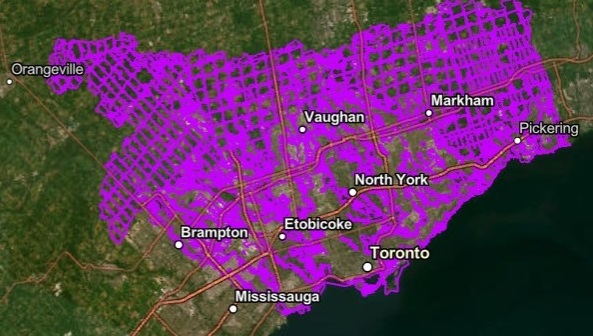
The regulated area represents the greatest physical extent of the combined TRCA regulated natural features and natural hazards (areas subject to flooding and erosion), plus a prescribed allowance, as set out in the Conservation Authorities Act and Ontario Regulation 41/24.
To find out if you may be in a Regulated Area, please use our Regulated Area Search.
For more information on how the Regulated Area is determined, please see the TRCA Annual Regulation Mapping Update page.
How do I find out if a property is affected by the Conservation Authorities Act and Ontario Regulation 41/24?
There are three options:
- Take advantage of Property Inquiry Service.
- Check our Regulated Area Search and consult with TRCA staff.
- Speak with a planner at TRCA’s head office walk-in counter service, open Monday to Friday, 8:30 a.m. to 4:30 p.m.
If a property is regulated, how do I find out what can be built there?
To obtain TRCA’s preliminary review of a specific development proposal on a property, your best course of action is to submit a Concept Development Application.
Will my application under the Planning Act be circulated to TRCA?
Municipalities have access to TRCA Regulated Area maps. In general, development applications wholly or partially within or adjacent to these areas will be circulated by the municipality to TRCA for comment.
If your development proposal falls within or is adjacent to the Regulated Area, then your application will likely be forwarded to the TRCA by your municipality.
TRCA’s review is separate from the municipality’s review. A separate fee schedule to cover the costs of administering plan review and technical clearance services applies.
To ensure a streamlined review process, please consult with your TRCA planner to ensure the correct review fee is paid when you submit your documents to your local municipal planning department, and that any additional supporting documents that TRCA staff have requested are included.
For a complete listing of fees, please refer to TRCA’s planning fee schedule.
For information and advice please contact a TRCA planner for your area and/or review TRCA guidelines.
TRCA staff will determine how your proposal may affect or be affected by natural hazards (flooding, erosion) and natural features important for managing natural hazards (river or stream valleys, wetlands, Lake Ontario shoreline, and areas/allowances around these features).
Staff will then forward comments to your municipality, recommending ways of protecting these features and protecting your development from the threat of flooding and erosion.
If necessary, you will be advised to apply for a permit under the Conservation Authorities Act and Ontario Regulation 41/24.
If TRCA staff have comments, the applicant should address in writing any comments or conditions before TRCA can provide clearance to the local municipality.