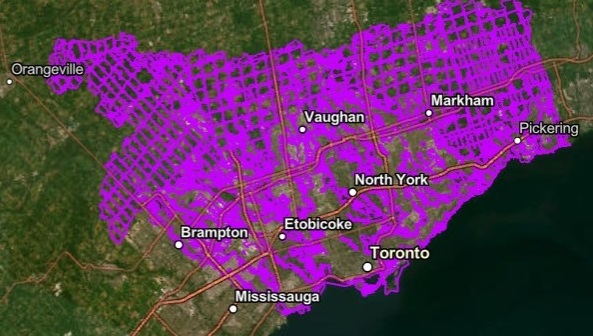
A permit from Toronto and Region Conservation Authority (TRCA) is required prior to beginning construction activities.
In particular, please note that under the applicable Building Code Act, a TRCA permit is required BEFORE receiving a building permit from your municipality.
Why Is This Necessary?
TRCA’s permitting process is mandated under the Conservation Authorities Act and Ontario Regulation 41/24: Prohibited Activities, Exemptions and Permits.
This process is important because it protects watercourses, wetlands, shorelines, and valley lands – and it protects you and your neighbours from flooding, erosion, and loss of greenspace.
If you are filling, changing grade, or building anything on a property within a TRCA Regulated Area, you need a permit from TRCA.
A TRCA permit is required before any of the following works take place:
- Activities to straighten, change, divert, or interfere in any way with the existing channel of a river, creek, stream, or watercourse, or to change or interfere in any way with a wetland.
- Development activity in: hazardous lands, wetlands, river or stream valleys, areas adjacent or close to the shoreline of Lake Ontario.
“Development Activity” is defined in Ontario Regulation 41/24 as:
- The construction, reconstruction, erection, or placing of a building or structure of any kind;
- Any change to a building or structure that would have the effect of altering the use or potential use of the building or structure, increasing the size of the building or structure or increasing the number of dwelling units in the building or structure;
- Site grading; or
- The temporary or permanent placing, dumping, or removal of any material, originating on the site or elsewhere.
TRCA may issue a permit if, in TRCA’s opinion, the activity is not likely to affect the control of flooding, erosion, dynamic beaches, or unstable soil or bedrock, and the activity is not likely to create conditions or circumstances that, in the event of a natural hazard, might jeopardize the health or safety of persons or result in the damage or destruction of property.
How it Works:
Pre-submission Consultation
It is important to discuss your proposal with a TRCA Development Planning and Permits Planner or an Infrastructure Planning and Permitting Planner prior to submitting a permit application.
This pre-submission consultation helps you with the following:
- Identifying how your proposal is affected by TRCA’s programs and policies.
- Identifying potential issues, constraints and study requirements.
- Informing you of what lies ahead in the permitting process, determining whether your proposal is supported in principle and what the anticipated processing timelines will be.
- Confirming what constitutes a complete application.
- Determining the limits of regulated natural hazards and features through a site visit, if required.
The submission of a complete application gives us an opportunity to review your application in a comprehensive, efficient and timely manner. To avoid delays in the permitting process, applicants are required to engage in pre-submission consultation.
Please note that it is the responsibility of an applicant to undertake due diligence to determine all required planning and permitting approvals.
How it Works: Submission Requirements
To ensure the interests of TRCA are met, and to appropriately assess the technical aspects of your proposal, we require the submission of a number of information items with your permit application.
Development Planning and Permits – Standard Requirements
- Completed and Signed Application Form
- Application Fee
- Covering Letter, which outlines the proposal, provides contact names and describes all pre-submission consultation and submission contents
- Full Set of Appropriate Plans/Drawings – Submissions should be digital, using an online file sharing service
- Legal Survey
Infrastructure Planning and Permits – Standard Requirements
- Completed and Signed Application Form
- Application Fee
- All submissions should be made in digital format only and include:
- Covering Letter, which outlines the proposal, provides contact names and describes all preliminary consultation and submission contents
- Full Set of Appropriate Plans/Drawings
- Note that for submissions greater than 50 MB in size (total), an online file sharing service should be used.
Associated Documents
Permit Application Forms:
- Development Planning and Permits Application Form
- Infrastructure Planning and Permits Application Forms
These applications are related to permits pursuant to the Conservation Authorities Act and Ontario Regulation 41/24.
TRCA Administrative Fee Schedules:
- TRCA Administrative Fee Schedule For Development Permitting Services
- TRCA Administrative Fee Schedule for Environmental Assessment and Infrastructure Permitting Services
TRCA’s Fee Schedules for Permitting Services were approved by TRCA’s Board of Directors by RES.#A 175/22 on November 10, 2022. The Fee Schedule adheres to the Ontario Ministry of Natural Resources “Policies and Procedures for Charging of Conservation Authority Fees”, TRCA’s Fees Policy/Guideline 2010 and TRCA’s Fee Policy. Service Delivery Agreements and/or Memoranda of Understanding with area municipalities or agencies.
Potential Technical Requirements
Please note that the scale and complexity of your proposal will determine which of the studies, reports or design drawings will be needed for your application.
The level of detail required for most of the studies and reports can vary widely depending on the property and the proposal. In some situations, a single-page letter from a qualified expert will be sufficient, while in other cases a major study will be necessary.
Meeting with a TRCA Development Planner or TRCA Infrastructure Planner prior to submitting your permit application will help determine which items must be provided to consider your application complete and to establish the requirements for, and the scope of, any studies, reports or design drawings.
TRCA’s checklists and technical guidelines should be consulted in preparation of your permit application.
Why Do We Need This Information?
Submitting the relevant documents, plans and/or reports allows TRCA staff to effectively review the proposed works and determine if they meet the requirements of the Conservation Authorities Act and Ontario Regulation 41/24 and TRCA’s Living City Policies.
Types of Permits
A permit can only be issued under the property owner’s name (not under the agent or contractor’s name) and is not transferable. Typically, permits are valid for two years, unless an extension is applied for at the initial application stage.
The following are the types of permits that your application will fall under:
Delegated Permits:
In order to streamline our permit process we have implemented a staff-delegated permit category which covers the following non-complex permissions:
- Permissions that are consistent with TRCA approved policies and procedures.
- Permissions that are for a time period of two years or less.
- Permissions for one-time extension, provided the time period is two years or less.
This initiative enables permits to be approved by designated staff and allows applicants to proceed within a timely manner rather than having to wait for monthly permit approval by TRCA’s Executive Committee. The review process still ensures compliance with our legal obligations under the Conservation Authorities Act and the Regulation.
Major Permits:
Permit applications that fall under the following criteria are subject to the approval of TRCA’s Executive Committee:
- Major projects that are significant in geographical area and/or for which submission of a suite of technical studies is required to demonstrate consistency with TRCA policies; these generally require more complex technical review and assessment.
- Permissions that extend beyond two years, up to a maximum of 60 months.
- Permissions for a one-time extension that extends beyond two years, up to a maximum of 60 months.
The Executive Committee generally meets on the first Friday of each month.
Permit Extension/Revision:
To be eligible for a permit extension or revision, an application form must be submitted at least 60 days prior to the expiry of the original permit, subject to the following conditions:
- Written confirmation that the project is unchanged and the plans and documents detailing the works are identical to those stamped approved by TRCA as part of the original permit. If minor modifications in keeping with the original permit are proposed, then a cover letter detailing the modifications and new plans or documents must be submitted.
- Property ownership as per the original permit is the same.
- The correct permit extension/revision fee is provided for Development Planning and Permits or Infrastructure Planning and Permits applications.
Permit Extension Application Forms:
- Development Planning and Permits – Permit Extension / Revision Application Form
- Permit TRCA Project Compliance Review Extension or Revision Application
These applications are related to an Extension/Revision Permit Application pursuant to the Conservation Authorities Act and Ontario Regulation 41/24)
Contact Information
Developer and Private Residence related Questions:
Contact: Development Planning and Permits
Public and Private Infrastructure related Questions
Contact: Infrastructure Planning and Permits