
With funding from the Ontario Ministry of the Environment, Conservation and Parks (MECP) and the Canada Water Agency, Toronto and Region Conservation Authority (TRCA) is leading an applied research project in support of the Land to Lake Initiative (L2L) in Western Lake Ontario.
Phase one of the project (2025/26) focused on developing a compendium of coastal resilience issues and a typology of nature-based/hybrid solutions that may be suitable for Western Lake Ontario.
Nature-based approaches use natural features and processes like vegetation, beaches, dunes, and wetlands to protect the shoreline.
Unlike traditional grey infrastructure (e.g., concrete sea walls), which is often designed for a single purpose, nature-based approaches can perform a variety of functions and provide multiple co-benefits (e.g., reduce stormwater runoff, reduce soil erosion, provide natural cooling, and provide recreational space and habitat for wildlife).

Increasingly, knowledge and techniques around nature-based approaches are improving to ensure that they are just as effective as hard features in protecting the shoreline.
In some cases, a hybrid (or combination) of natural and hard features may be used.
Explore our technical report, visual guide, and online StoryMap and data explorer to learn more.
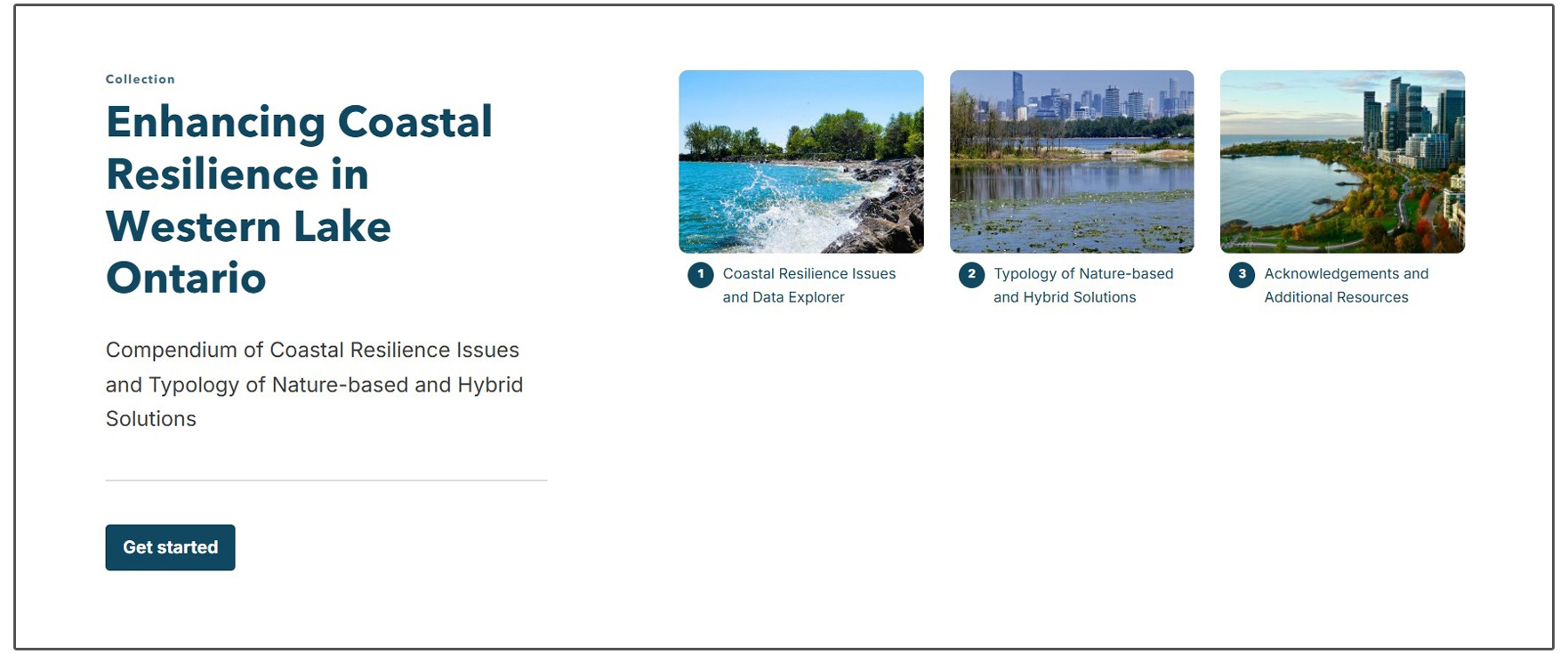
StoryMap
Select the thumbnail image below to open the StoryMap in a new tab.
Technical Report
Compendium of Coastal Resilience Issues and
Typology of Nature-based and Hybrid Solutions
Select the thumbnail image below to download the technical report
Appendices
Literature Review Reference List
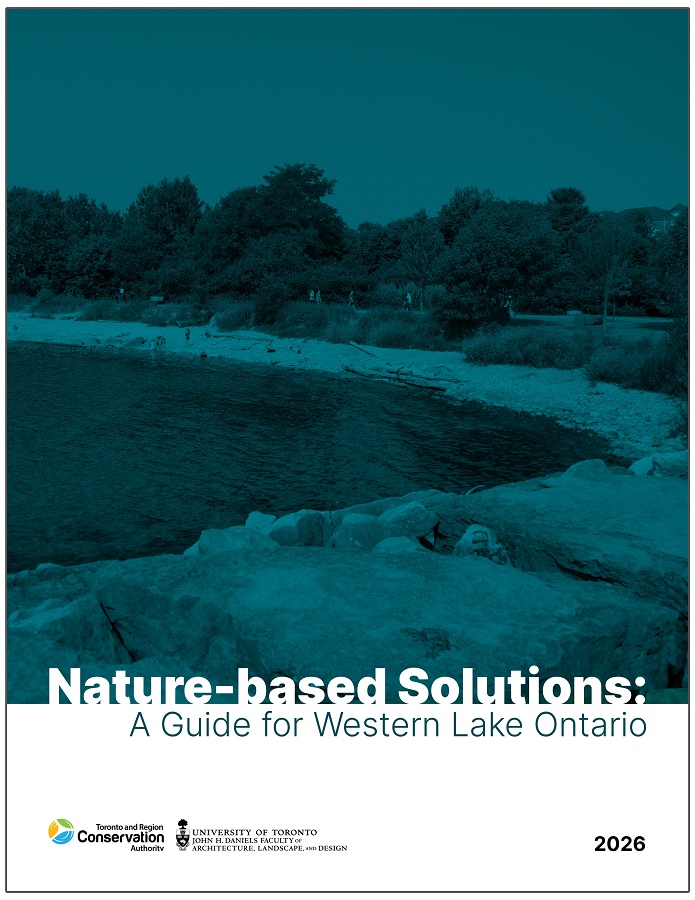
Visual Guide
Nature-based Solutions: A Guide for Western Lake Ontario
Select the thumbnail image below to download the visual guide
Next Phase
With grant funding from the Canada Water Agency’s Great Lakes Freshwater Ecosystem Initiative, the next phase of this study (2026/28) will focus on:
- Conducting a coastal climate risk and vulnerability assessment, with a focus on the shoreline stretching from Mississauga and Cobourg, to align with the Lake Ontario Coastal Resilience Project, a parallel project led by Niagara Peninsula Conservation Authority (NPCA), Hamilton Conservation Authority (HCA), and Conservation Halton (CH).
- Working with the National Research Council’s (NRC’s) Ocean, Coastal and River Engineering Research Centre to undertake coastal modelling to inform the risk and vulnerability assessment and identification of priority areas for enhanced coastal resilience by combining regional- and local-scale modelling to evaluate the detailed performance of nature-based solutions at select locations.
- Developing a map-based prioritization tool in partnership with researchers at the University of British Columbia’s (UBC’s) Coastal Systems Engineering Lab to identify strategic locations for nature-based and hybrid solutions, building on the results of this compendium.
- Integrating these results into an integrated Coastal Resilience Options Guide to provide further place-based information to support the practical implementation of nature-based and hybrid solutions where they are needed most.
Contact Information
For more information, please contact
TRCA’s Watershed Planning and Ecosystem Science team:
wpes@trca.ca